


1. Introduction
2. Preliminary Design Method based on CEA
3. Results and Discussion
3.1 AP-based HTPB solid propellants
3.2 Nitramine-based NEPE solid propellants
4. Conclusion
1. Introduction
SRMs (Solid Rocket Motors) have historically served as the primary propulsion system for guided missiles and tactical weapons owing to their structural simplicity, high reliability, cost-effectiveness and excellent long-term storage stability [1,2]. However, the current evolution of missile technology demands precision control capability, including sophisticated terminal guidance and trajectory correction which enable high mission flexibility [3]. Traditionally, such precise thrust control has been realized through liquid propulsion systems. Despite their superior controllability, liquid propulsions suffer from inherent disadvantages such as system complexity, high manufacturing cost, and limited long-term storability, which restrict their suitability for tactical and strategic missile applications [1,4].
To overcome these limitations, significant research efforts have been focused on developing variable thrust solid rocket motors that retain the advantages of solid propulsion while providing active thrust control [5,6]. Among various thrust modulation concepts, the systems utilizing a pintle mechanism for regulating the burning surface area have recently attracted considerable attention due to their fast response times and high control precision [7,8]. In pintle-controlled SRMs, thrust modulation is primarily realized via chamber pressure variation caused by pintle movement, making the combustion response characteristics of the propellant a critical design consideration [7,9].
For a solid rocket motor under quasi-steady conditions, the chamber pressure is determined by the balance between propellant mass generation and nozzle mass discharge [1,10]. By combining the classical burning rate law with the nozzle flow relation, the chamber pressure can be expressed as
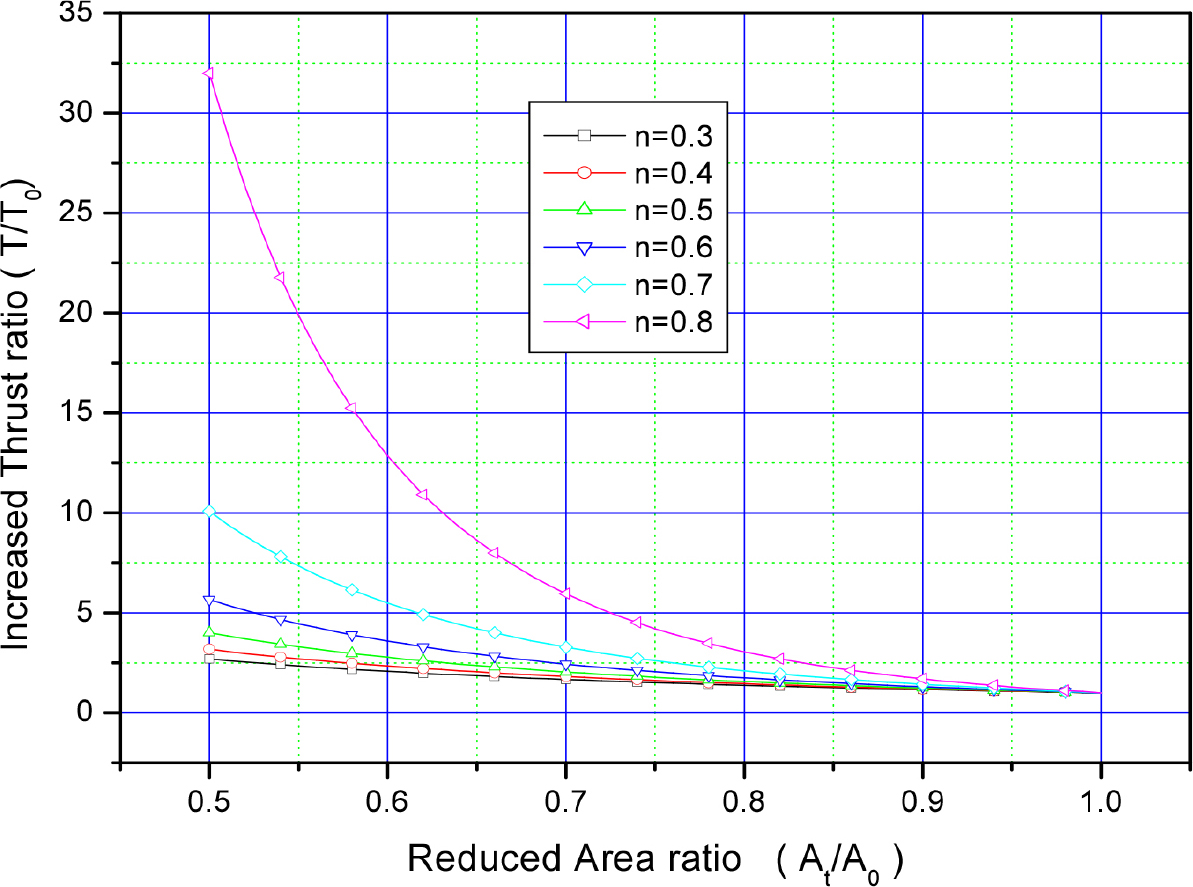
Where Pc is the chamber pressure, ρp is the density of the propellant, a is the burning rate coefficient, Cd is the coefficient of discharge, Ab is the burning area and At is the nozzle throat area [10,11]. This relationship indicates that the sensitivity of chamber pressure to throat area variation increases dramatically as the pressure exponent approaches unity [11]. Consequently, in pintle-controlled SRMs, even small changes in throat area via pintle motion can result in considerable variation in chamber pressure and thrust when high-pressure-responsive (high pressure exponent, > 0.6) propellants are incorporated as shown in Fig. 1[7,12]. Such behavior is advantageous for achieving high responsive thrust modulation but simultaneously amplifies thermal and structural loads on thrust control hardware [6,8].
From a system-level perspective, the thermal survivability of thrust control systems, such as the pintle and nozzle insert, represents a fundamental design constraint [6,13]. These components are directly exposed to high-temperature combustion gases, and their durability is greatly influenced by the propellant flame temperature [1,14]. Therefore, prior to pursuing aggressive pressure exponent enhancement, the flame temperature must be carefully evaluated as a primary consideration in the preliminary design of variable thrust solid rocket motors [14,15].
Despite extensive study on throttleable solid rocket motors, the majority of previous research has predominantly focused on thrust control mechanisms and hardware configuration, while comparatively limited attention has been given to formulation-level strategies that explicitly account for both controllability and thermal constraints [5,8,14,16]. In particular, a systematic methodology for the preliminary formulation design of solid propellants tailored to pintle-controlled thrust modulation - incorporating flame temperature considerations - has not been sufficiently established in the literature.
In this study, a preliminary formulation design approach for variable-thrust solid propellants is proposed based on thermochemical equilibrium analysis using the NASA CEA (Chemical Equilibrium with Applications) code [17,18]. Two representative propellant families showing distinct combustion mechanisms – AP (Ammonium Perchlorate)-based solid propellants and nitramine oxidizers such as RDX, HMX and HNIW-based solid propellants -are investigated [2,14]. By systematically analyzing flame temperature and key combustion properties, this work aims to identify the potential formulations available for pintle-controlled variable-thrust solid rocket motors and to provide a foundation for subsequent experimental validation and formulation optimization.
2. Preliminary Design Method based on CEA
A preliminary formulation design for variable-thrust solid propellants was carried out through a thermochemical equilibrium analysis. The NASA CEA (Chemical Equilibrium with Applications) code was employed to investigate the combustion characteristics of potential propellant formulations, especially focusing on flame temperature as a key parameter for pintle-controlled thrust systems. The chamber pressure in the CEA calculations was fixed at 6.89 MPa, representing a typical operating pressure range for tactical solid rocket motors carrying thrust modulation devices. The nozzle expansion ratio was set to 68:1. The combustion temperature used in the present analysis corresponds to the equilibrium temperature in the combustion chamber, rather than the temperature at the nozzle throat or exit, since the thermal load on the pintle-controlled system is primarily governed by the chamber gas temperature.
The propellant formulations considered in this work were based on representative compositions of composite HTPB propellants and NEPE (Nitrate Ester Plasticized Polyether) propellants, which show distinct combustion mechanism. Metallic fuel additives were intentionally excluded from all formulations. In a pintle-driven system, metal particles and their combustion residues may cause mechanical erosion of the pintle surface and partial blockage between the pintle tip and the nozzle throat due to the accumulation of metal oxides. Such phenomena can degrade thrust modulation performance and compromise operational reliability, particularly under repeated or rapid pintle actuation.
The oxidizer system was designed in a bimodal configuration consisting of AP combined with a nitramine oxidizer, aiming to achieve elevated pressure sensitivity while maintaining controllable combustion characteristics. For the HTPB-based propellants, RDX was selected as the nitramine oxidizer, whereas HMX was incorporated for the NEPE-based propellants, reflecting typical formulations reported in the literature. For NEPE propellants, several binder systems were employed, including PCE (Polycaprolactone Ether), PCL (Polycaprolactone), PEG (Polyethylene Glycol), and GAP (Glycidyl Azide Polymer), which have been extensively investigated for high-energy NEPE applications. As a plasticizer used in binder formulations, BuNENA (Butyl-Nitratoethyl Nitramine) was employed in PCE-based solid propellants and the mixture of BTTN (Butanetriol Trinitrate) and TMETN (Trimethylol Trinitrate) was incorporated in other polymer-based propellants. The propellant compositions analyzed in this work were not intended to represent finalized formulations, but rather to serve as representative baseline systems for evaluating thermochemical trends relevant to variable-thrust solid rocket motors.
The CEA-based analysis focused on identifying formulation trends that enable reduced flame temperature which is primarily considered for pintle-based motors, while preserving favorable combustion performance, thereby providing a preliminary screening tool for propellant candidates suitable for pintle-controlled thrust modulation. The results of this analysis were subsequently used to compare the thermochemical behavior of AP-based propellants and NEPE propellants under identical operating conditions.
3. Results and Discussion
Composite solid propellants based on HTPB and AP have been most widely used in guided missile propulsion systems. The pressure exponent of typical HTPB/AP propellants generally falls within the range of 0.2 to 0.5. When aluminum particle is employed at loading levels of approximately 20 wt%, the pressure exponent is further reduced to values below 0.2, while the adiabatic flame temperature exceeds 3,000 K. Owing to both the low-pressure sensitivity and the excessively high flame temperature, aluminized AP composite propellants are not well suited for application requiring high pressure exponent characteristics, such as variable-thrust solid rocket motors.
In contrast, NEPE propellants using nitramine oxidizers such as RDX, HMX, and HNIW, instead of ionic oxidizers like AP, typically exhibit significantly higher pressure exponents, often exceeding 0.7 [19,20]. For this reason, NEPE propellants intended for conventional rockets are frequently modified through the addition of burn rate modifiers or by adding secondary oxidizers, such as AP, to reduce the pressure exponent to acceptable levels for stable operation. Despite the substantial differences in adiabatic flame temperature between AP-based and nitramine-based solid propellants, the burning rates of monopropellant systems containing AP or nitramine oxidizers alone are often comparable. However, when applied in composite solid propellant formulations, AP-based systems generally convey higher flame temperatures and burning rates than nitramine-based systems under identical operating conditions. These differences originate from fundamentally distinct combustion mechanisms governing the two oxidizer systems.
In AP-based systems, combustion is primarily dominated by heterogeneous reactions between AP particles and the polymeric binder, leading to the formation of a primary flame located very close to the propellant surface. Strong heat feedback from this near-surface flame to the burning surface promotes rapid thermal decomposition and results in a relatively small temperature gradient between the flame zone and the condensed phase. By contrast, in nitramine-based formulations, a molten condensed layer forms at the burning surface during combustion. This condensed layer plays a role as a thermal sink, reducing heat feedback from the gas-phase flame to the surface. As a result, the flame zone is displaced away from the burning surface by a finite stand-off distance. This spatial separation produces a larger temperature difference between the burning surface and the flame, leading to enhanced sensitivity of the burning rate to chamber pressure and, consequently, a higher pressure exponent. A similar combustion behavior has also been observed in AN (Ammonium Nitrate)-based propellants, where extensive melting of the oxidizer leads to the formation of a thick condensed layer. Owing to this pronounced condensed-phase heat sink effect, AN-based solid propellants often exhibit even higher pressure exponents than nitramine-based propellants [21].
3.1 AP-based HTPB solid propellants
Fig. 2 illustrates the variation in adiabatic flame temperature as a function of the mass fraction of HTPB binder, AP, and RDX. As expected, an increase in the content of solid oxidizer particles, namely AP and RDX, leads to a higher flame temperature [21]. However, the magnitude of this increase is markedly more pronounced for AP than for RDX. In particular, for AP-rich formulations, the addition of RDX results in flame temperatures exceeding 2,900 K, which is significantly higher than the typical flame temperature of baseline HTPB/AP propellants, generally around 2,800 K.
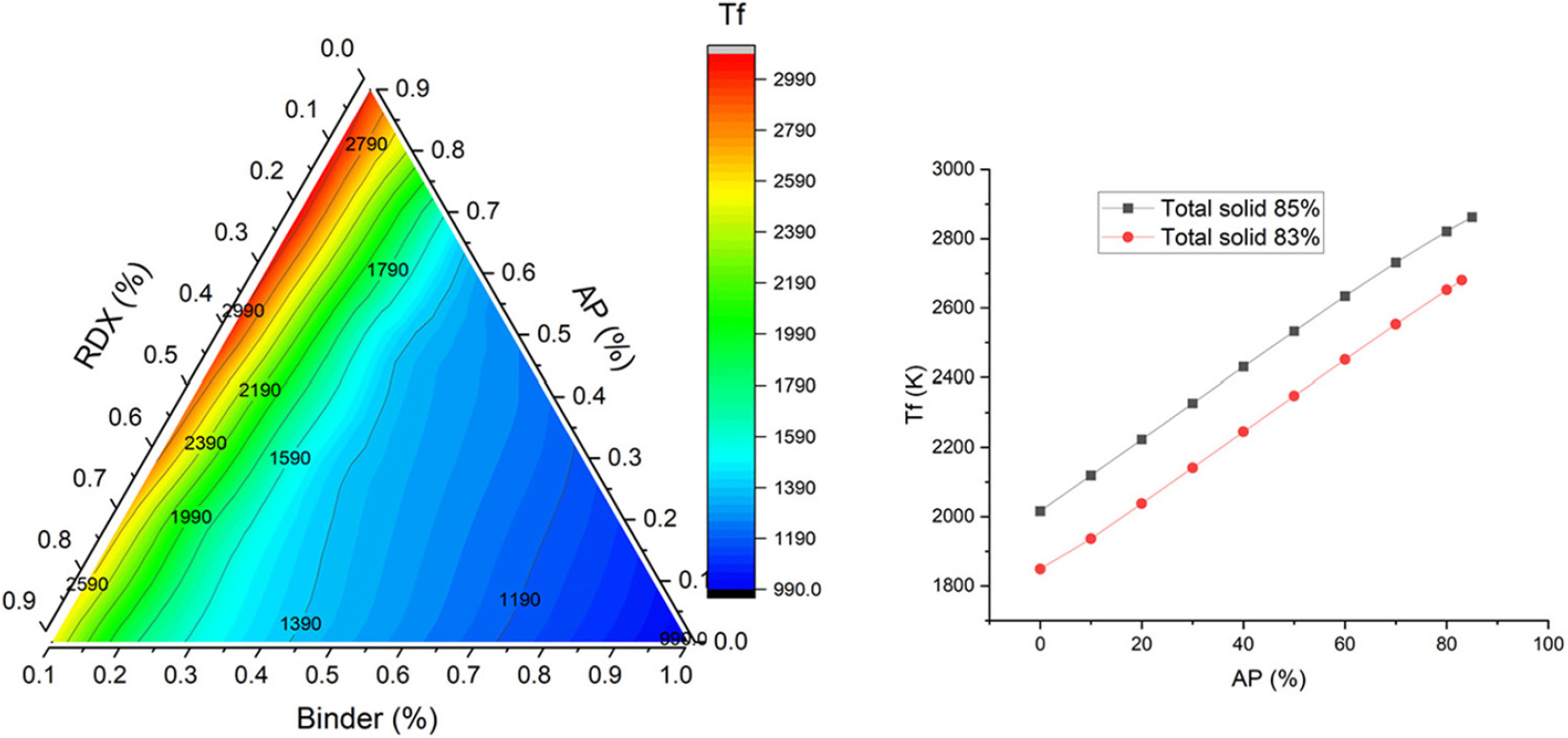
As shown in Fig. 2 right, when AP and RDX are employed in combination, the increase in flame temperature with increasing RDX content under a fixed AP loading exhibits a nearly linear and remarkably consistent trend. This behavior suggests that, although RDX contributes to an increase in pressure exponent, its influence on flame temperature in mixed-oxidizer systems is predictable and additive in examined composition range. From a hardware perspective, particularly for thrust control devices such as pintles, lower flame temperatures are generally desirable to ensure sufficient thermal margin and material durability. On the other hand, propulsion performance metrics such as specific impulse impose an opposing requirement for elevated combustion temperature. Based on these competing considerations, propellant formulations exhibiting flame temperature on the order of approximately 2,500 K represent a reasonable compromise. In this temperature regime, formulations with a total solid loading of around 80 wt% appear to be reasonable candidates.
Although the incorporation of RDX can be beneficial for increasing the pressure exponent, excessively high RDX contents (above around 30 wt%) may adversely affect the burning rate of HTPB/AP composite propellants. In such cases, higher chamber pressure would be required to maintain adequate thrust levels, which in turn could impose increased mechanical and thermal loads not only on the combustion chamber but also thrust modulation hardware. Therefore, for rocket motors requiring only a limited thrust modulation range, i.e., a modest turn-down ratio, it is preferable to prioritize an appropriate trade-off between flame temperature and specific impulse rather than maximizing the pressure exponent. Under such conditions, the present results indicate that formulations predominantly based on AP as the primary oxidizer, with only a minimal addition of RDX, provide a more balanced solution for pintle-driven variable-thrust solid rocket motors.
3.2 Nitramine-based NEPE solid propellants
3.2.1 Inert polymer-based solid propellants
A distinct feature observed in the ternary contour plots in Fig. 3 is the significantly broader distribution of flame temperature for NEPE-based propellants compared with HTPB-based composite propellants. In particular, high-temperature regions are distributed over a much wider composition range in NEPE formulations than in HTPB/AP systems. For HTPB/AP propellants, high flame temperature zones are mainly confined to compositions with total solid loadings exceeding approximately 80 wt%. In contrast, nitramine-based NEPE propellants exhibit extensive high-temperature regions even at oxidizer contents below 70 wt%. This tendency is most pronounced for PEG-based NEPE formulations, where flame temperatures exceeding 3,000 K are observed even at oxidizer loadings below 50 wt%. Among the investigated inert polymer binders, PEG-based solid propellants therefore display the widest distribution of high flame temperature regions.
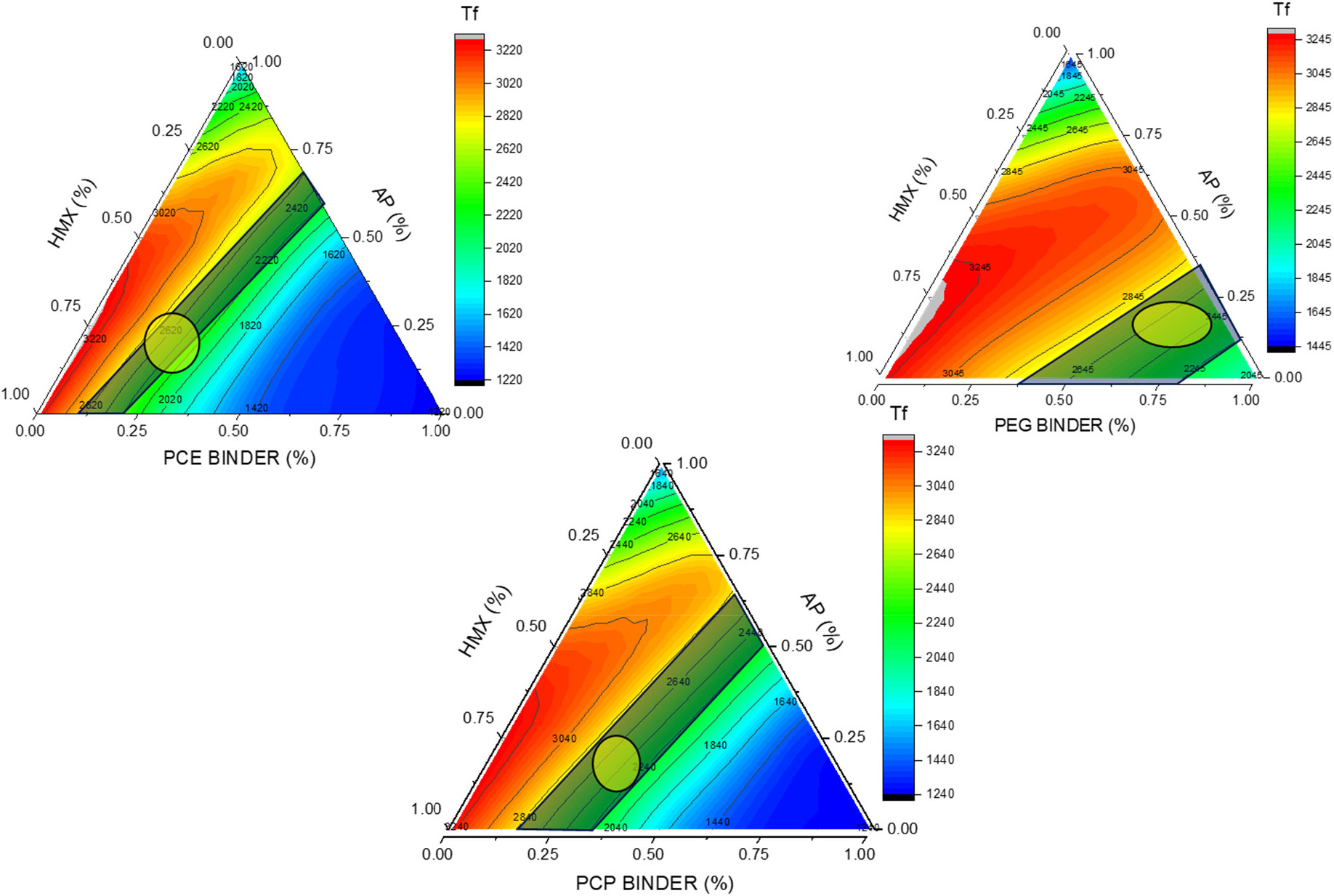
This behavior can be attributed primarily to the characteristics and loading levels of the energetic plasticizers employed in the NEPE formulations. Unlike PCL- or PCE-based propellant, PEG-based propellants incorporate a high-energy mixed plasticizer employed is substantially higher. In the present formulations, the plasticizer-to-polymer ratio for PEG-based propellants is around four times that of the polymer, which is considerably higher than those used in other NEPE systems. The high plasticizer content is required to melt the high-molecular-weight PEG, which is supplied in the form of solid powder, and to suppress crystallization upon cooling to ambient temperature. As a result, the large fraction of energetic plasticizer contributes directly to the elevated flame temperature and the broad high-temperature distribution observed in the ternary contour map. In contrast, PCL- and PCE-based solid propellants require greatly lower contents due to their lower molecular weight, typically on the order of 1~1.5 times the polymer mass. Furthermore, PCE-based formulations employ a less energetic plasticizer, such as BuNENA, instead of BTTN/TMETN mixture. Consequently, the high flame temperature region for PCE-based propellants is noticeably narrower than the observed for PCL-based systems.
Based on the ternary contour maps shown in Fig. 3, the allowable binder content ranges for different polymer systems can be identified by prioritizing both flame temperature and performance. For PCE-based propellants, the binder content is estimated to fall within approximately 15~20 wt%. In the case of PCL-based propellants, a broader binder range of 20~35 wt% is indicated, whereas PEG-based propellants require substantially higher binder contents, typically in the range of 40~80 wt%, to mitigate excessive flame temperature. However, as also evident from Fig. 3, propellant formulations incorporating a single oxidizer system composed solely of either HMX or AP tend to exhibit extreme combustion characteristics, resulting in either excessively high or undesirably low flame temperatures. To achieve a balanced combination of high pressure exponent and moderate burning rate, a mixed oxidizer system is required. The present analysis indicates that such formulations should contain less than approximately 20 wt% AP and more than around 40 wt% HMX.
When these oxidizer constraints are combined with binder content considerations, the feasible formulation space becomes considerably narrower. For PCE-based propellants, a binder content of approximately 20~25wt% appears to provide a reasonable compromise. Similarly, PCL-based propellants exhibit an optimal binder range of 25~30 wt%. Although PEG-based propellants require very high binder contents, on the order of 55~65 wt% to suppress flame temperatures to acceptable levels, such formulations inherently suffer from excessively low solid loading. Under these conditions, uniform dispersion of solid oxidizer particles becomes difficult, and oxidizer sedimentation during the casting process is likely to occur. These effects may lead to combustion instability during motor operation, rendering PEG-based formulations less attractive for practical application despite their high energetic potential.
3.2.2 Energetic polymer-based solid propellants
In the preceding section, NEPE propellants formulated with inert polymer binders were shown to exhibit strong constraints on plasticizer content, primarily due to processing requirements and crystallization control. In contrast, NEPE systems based on GAP offer substantially greater formulation flexibility with respect to plasticizer loading. This flexibility originates from the intrinsic physical characteristics of GAP, which exists in a liquid state at ambient temperature and possesses a relatively Tg of approximately -35°C. Unlike solid inert polymers, GAP does not require a predefined minimum amount of plasticizer to induce melting or to suppress crystallization during cooling. As a result, the plasticizer content in GAP-based NEPE propellants is no longer dictated by processing constraints, but instead serves primarily as a design parameter for tailoring the thermomechanical properties of the formulation.
Accordingly, the plasticizer loading in GAP-based propellants predominantly governs the resulting glass transition temperature of the binder system and can be adjusted to satisfy the environmental and operational temperature requirements of the rocket motor. This decoupling of plasticizer content from processing limitations represents a fundamental distinction from inert polymer-based NEPE formulations. The impact of this enhanced formulation flexibility on energetic performance is illustrated in Fig. 4 (as earlier discussed briefly in our study [22]), which presents flame temperature distributions as a function of plasticizer content. As anticipated, increasing the plasticizer fraction leads to a systematic expansion of high flame temperature regions across the compositional space. This behavior reflects the growing energetic contribution of the plasticizer and, more broadly, the inherently energetic nature of the GAP-based binder system. Beyond plasticizer flexibility, GAP itself contributes to combustion enhancement due to its energetic backbone, which can promote higher burning rates [23,24,25]. Consequently, GAP-based NEPE propellants require significantly less AP to achieve comparable or superior burning performance relative to inert polymer-based systems. This reduced dependence on AP enables a higher fraction of HMX to be employed, thereby providing greater freedom to adjust the pressure exponent over a wider operational range.
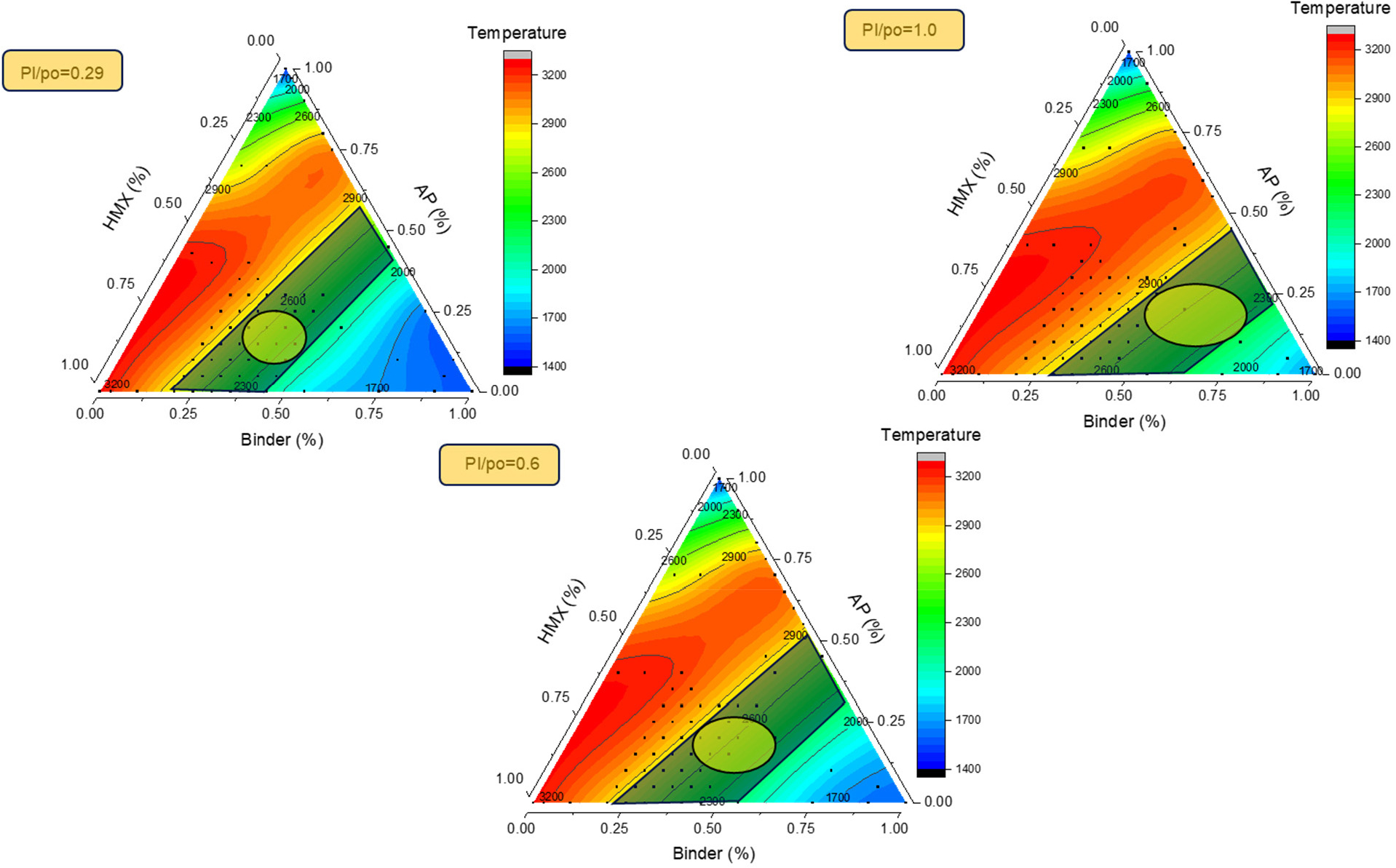
Fig. 4 further illustrates the influence of plasticizer-to-polymer ratios (Pl/po) of 0.29, 0.6 and 1.0 on the compositional characteristics of GAP-based propellants. Based on the corresponding flame temperature distributions, the suitable binder content-defined as the combined mass fraction of polymer and plasticizer-is estimated to lie within approximately 0.25~0.35 for Pl/po = 0.29, 0.35~0.45 for Pl/po = 0.6, and 0.45~0.55 for Pl/po = 1.0. As the plasticizer fraction increase relative to the polymer, the overall binder content increases accordingly, resulting in a reduction of the total solid oxidizer fraction. From a processing perspective, this reduction in solid loading is advantageous, as it lowers slurry viscosity and improves castability. However, when excessive plasticizer is introduced-as in the case of Pl/po = 1.0- the solid particle concentration becomes sufficiently low that achieving a uniform dispersion of oxidizer particles may be challenging owing to possible sedimentation of solid particles within cured solid propellants. Conversely, if the binder fraction is too low, the high concentration of solid particles can lead to a pronounced increase in viscosity during processing, potentially causing manufacturing difficulties (the viscosity available for processing is known to be less than 10.0 kp, depending the kind of solid propellants such as HTPB or NEPE propellants). Taking into account both dispersion stability and processability, a plasticizer-to-polymer ratio in the range of approximately Pl/po = 0.5~0.6 appears to offer the most balanced formulation for GAP-based NEPE propellants.
To further refine the formulation, Fig. 5 examines the influence of AP content on flame temperature as a function of plasticizer loading, presented separately for different total solid contents. Although an optimal binder fraction was identified in the preceding analysis, this figure provides additional insight into the appropriate total loading and the corresponding AP fraction within the oxidizer system. As shown in Fig. 5, increasing the overall solid content significantly amplifies the sensitivity of flame temperature to plasticizer concentration, resulting in an expanded high-temperature region. Under the previously identified optimal plasticizer-to-polymer ratio (Pl/po = 0.5~0.6), formulations with a solid loading of 70 wt% exhibit flame temperature exceeding approximately 2,700 K, which may impose substantial thermal stress on the pintle. In contrast, propellants with solid loadings of 55 wt% and 60 wt% achieve more moderate flame temperatures on the order of 2,500 K. Notably, compared with the 55 wt% formulation, the 60 wt% solid-loading composition allows for a reduced reliance on AP. By considering both the relatively high pressure exponent associated with AP and the capability to tailor burning rate through AP particle size control, a formulation containing only 15 wt% AP can still achieve flame temperature in the range of 2,500~2,600 K.
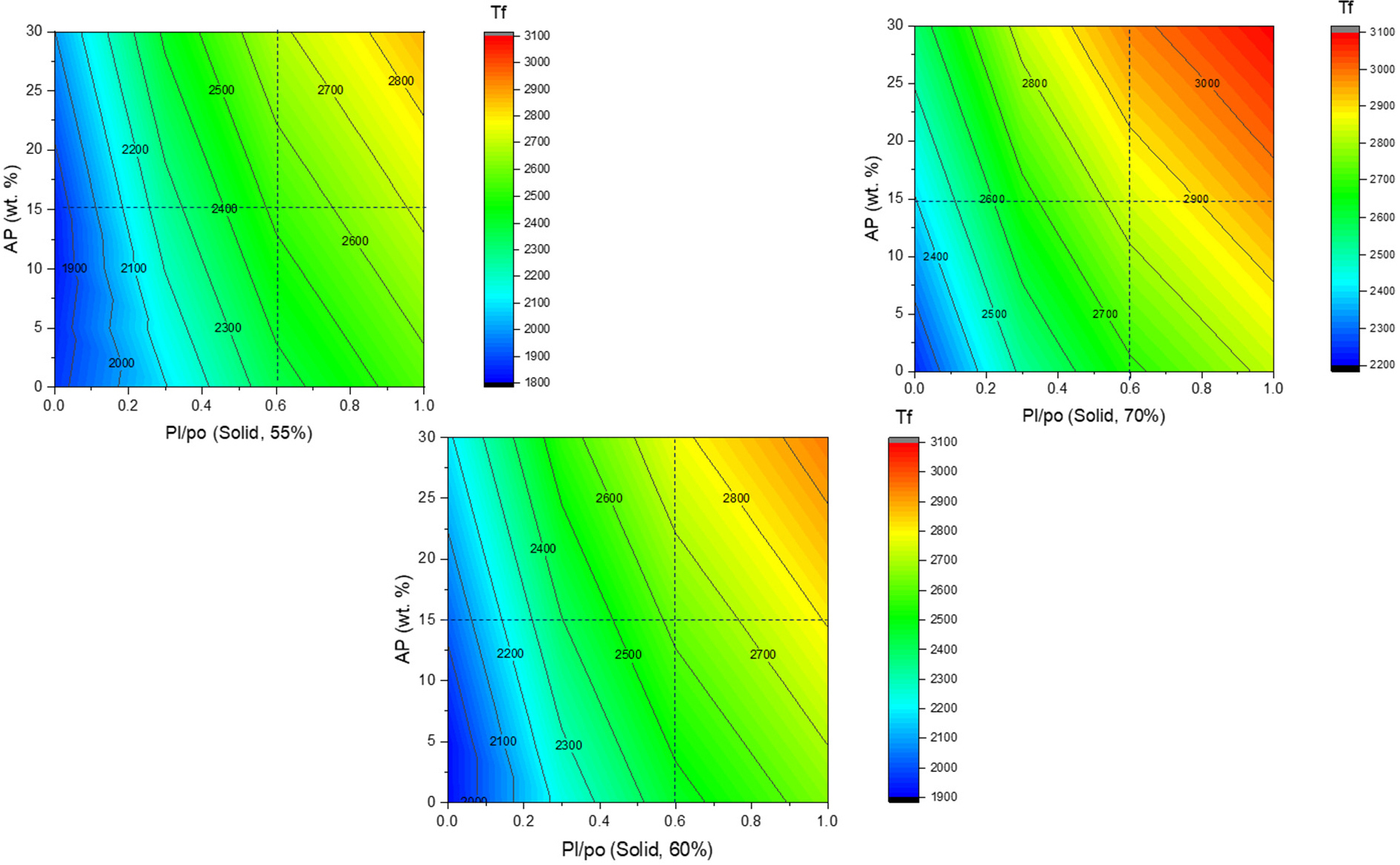
Finally, Fig. 6 provides a more detailed visualization of the combined effects of plasticizer content and total solid loading on flame temperature at a fixed AP content of 15 wt%. The solid loading is incrementally increased from 55 wt% to 75 wt% in steps of 5 wt%, illustrating the corresponding evolution of flame temperature with plasticizer fraction. As indicated in Fig. 6, when the plasticizer-to-polymer ratio approaches Pl/po = 0.6, formulations with solid loadings in the range of 55~60 wt% are predicted to yield flame temperatures of around 2,500~2,600 K. Consistent with the discussion above, this temperature range represents a favorable compromise between energetic performance and thermal management, supporting its suitability for practical GAP-based NEPE propellant designs.

3.2.3 Comparative assessment of flame temperature as a function of solid loading and AP content
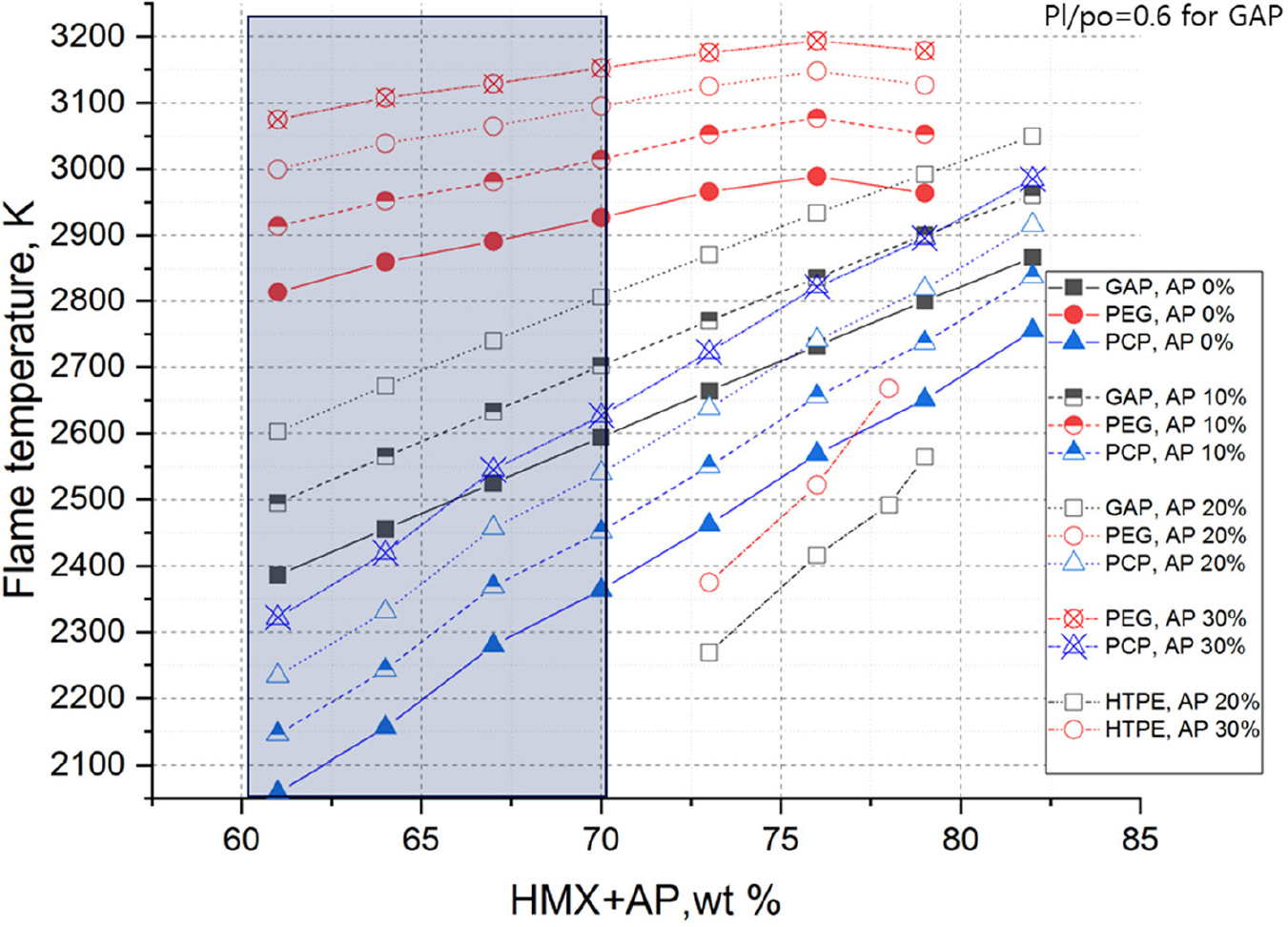
Fig. 7 provides an integrated comparison of the flame temperature characteristics of inert polymer-based NEPE propellants and GAP-based NEPE propellants as functions of total solid loading and AP content. For the GAP-based formulations, the plasticizer-to-polymer ratio was fixed at Pl/po = 0.6. In addition, the practically applicable solid-loading range, defined as the combined content of HMX and AP, was highlighted in the range of 60~70 wt%, taking propellant processability into account, as discussed earlier. One of the most evident observations from Fig. 7 is that, although PEG-based propellants exhibit the highest energetic performance, their excessively high flame temperatures render them impractical for application in pintle-based variable-thrust rocket motors, where thermal loads on the thrust control device become a critical limitation. In contrast, PCE-based propellants show comparatively lower flame temperatures than other inert polymer-based formulations; however, this advantage is accompanied by reduced energetic performance. Achieving a reasonable performance level with PCE-based propellants requires both high solid loading and increased AP content, which is expected to be unfavorable from the standpoint of the pressure exponent of the burning rate.
By comparison, GAP- and PCP-based propellants offer a broader and more flexible compositional design space, enabling the selection of multiple viable formulations within the practical solid-loading range. From a flame temperature perspective, GAP-based propellants consistently exhibit higher flame temperatures than PCP-based propellants at the same solid loading. This behavior implies that, for a given target flame temperature, GAP-based propellants can achieve comparable thermal conditions at lower AP contents and reduced solid loading relative to PCP-based systems, providing advantages not only in combustion performance but also in processing robustness. Nevertheless, despite their comparatively lower energetic performance, PCP-based propellants remain highly attractive for applications requiring long-duration operation with limited thermal stress on thrust control components, such as pintle mechanisms. In particular, when flame temperatures below approximately 2,300 K are required, along with an intentional increase in the pressure sensitivity of the burning rate, PCP-based formulations represent a well-balanced and practical propellant option. These trade-offs and application-specific advantages are clearly illustrated in Fig. 7.
4. Conclusion
This study presented a flame-temperature-based preliminary formulation strategy for pressure-responsive solid propellants intended for variable-thrust solid rocket motors employing pintle-type thrust control. Three representative propellant classes-conventional HTPB/AP composite propellants, inert polymer-based NEPE propellants, and GAP-based energetic binder formulations - were systematically examined using thermochemical equilibrium analysis. For HTPB/AP propellant, the results confirmed that increasing total solid loading and oxidizer content leads to a monotonic rise in adiabatic flame temperature. The inclusion of RDX as a secondary energetic component increased flame temperature in a nearly linear and predictable manner under fixed AP loading, thereby expanding the formulation design space. However, excessive RDX contents were found to drive flame temperatures beyond levels compatible with pintle hardware, while also potentially degrading burning-rate characteristics, indicating that only limited RDX additions are desirable for motors requiring modest thrust modulation. Inert polymer-based NEPE propellants exhibited comparatively lower flame temperatures and stable combustion behavior over a wide composition range. Nevertheless, achieving meaningful pressure responsive combustion within acceptable flame temperature limits required high solid and AP loadings, which may impose unfavorable constraints on processing and pressure exponent tailoring. These formulations are therefore better suited for long-duration operation with strict thermal margins rather than aggressive thrust modulation. In contrast, GAP-based propellants demonstrated superior formulation flexibility. Owing to the energetic nature of the binder and its reduced dependence on plasticizer content, these systems enable higher pressure responsiveness at moderate flame temperatures and lower AP dependence. This characteristic allows for more effective decoupling of flame.
Temperature control from pressure-sensitive combustion tuning, offering clear advantages for pintle-controlled variable-thrust applications. Overall, the present results demonstrate that adiabatic flame temperature serves as an effective unifying metric for preliminary formulation screening, linking energetic performance, pressure-responsive combustion behavior, and thermal compatibility with thrust control hardware. The proposed flame-temperature-guided formulation strategy provides a rational foundation for narrowing candidate compositions prior to experimental validation and supports systematic propellant selection for pressure-responsive variable-thrust solid rocket motors.