


1. Introduction
2. Experimental Approach
2.1 Supercritical density measurement
2.2 Supercritical viscosity measurement
2.3 Supercritical thermal conductivity measurement
3. Results and Discussion
4. Conclusion
1. Introduction
Supersonic and hypersonic aircraft can be classified into various categories according to their operational objectives, including supersonic UAV (Unmanned Aerial Vehicles), supersonic fighters, hypersonic cruise missiles, and hypersonic fighter platforms [1]. The propulsion systems adopted for these vehicles vary according to their applications, including turbojet-, ramjet-, and scramjet-based configurations, which consequently determine the attainable flight Mach number range. As the flight speed increases from the supersonic to the hypersonic regime, extremely high heat fluxes are imposed on the combustion chamber and nozzle regions due to intense aerodynamic heating and combustion processes [2,3,4]. In particular, the total temperature within the combustion chamber can approach approximately 4,000 K at Mach 8 [5,6]. To prevent structural failure and ensure stable operation under such severe thermal environments, regenerative cooling systems are widely employed in high-speed aircraft [6,7,8]. In regenerative cooling systems, the fuel is circulated through cooling channels embedded within the engine walls, where it absorbs heat prior to combustion [2,6]. Under high heat flux conditions, the fuel temperature inside the cooling channels can increase beyond its critical point, entering a high-temperature supercritical regime. Once the fuel reaches the supercritical region, key thermophysical properties, including density, viscosity, specific heat, and thermal conductivity, exhibit highly nonlinear variations with temperature and pressure [7,8]. Moreover, thermal decomposition reactions are initiated at elevated temperatures, leading to a rapid increase in coking risk. Coking within cooling channels may result in heat transfer deterioration and channel blockage [9,10]. The strong nonlinearity of thermophysical properties beyond the critical point, combined with coking phenomena, introduces substantial uncertainty in the prediction of heat transfer behavior and pressure drop within regenerative cooling channels. Therefore, precise knowledge of fuel thermophysical properties under supercritical conditions is essential for the reliable thermal performance assessment and design of regenerative cooling systems.
To obtain supercritical thermophysical property data of fuels, several studies have utilized EOS (Equation-of-State) or correlation-based prediction models. Li et al. [11] investigated heat transfer characteristics of supercritical EHFs (Endothermic Hydrocarbon Fuels) flowing through a horizontal tube under high heat flux conditions, with particular emphasis on the effects of near-wall pyrolysis. Thermodynamic properties of EHFs, including density and specific heat, were evaluated using the PR (Peng-Robinson) equation of state, while transport properties such as viscosity and thermal conductivity were calculated using the Chung model with high-density corrections. Kim et al. [12] conducted conjugate heat transfer analyses of regenerative cooling channels for a ram/scramjet dual-mode aircraft using n-decane as a surrogate fuel under supercritical conditions. They predicted the supercritical thermodynamic properties (internal energy and specific heat) of n-decane using the RK-PR (Redlich-Kwong-Peng-Robinson) equation of state. Transport properties (viscosity and thermal conductivity) were assessed using the Chung model with Brulé-Starling correction. In addition to individual research efforts, the NIST REFPROP (Reference Fluid Thermodynamic and Transport Properties Database) [13] is widely used to obtain supercritical thermophysical properties of fuels. In REFPROP [13], thermodynamic properties such as density, internal energy, and specific heat are evaluated using multi-parameter Helmholtz energy-explicit equations of state, which serve as the default and most accurate formulations. Transport properties, including viscosity and thermal conductivity, are calculated using a combination of dilute-gas contributions and residual terms based on the ECS (Extended Corresponding States) method, with density provided by the underlying Helmholtz EOS. Consequently, REFPROP [13] provides thermodynamically consistent predictions of both thermodynamic and transport properties over wide temperature and pressure ranges, including the supercritical regime. Overall, previous studies have relied on prediction models based on EOS and correlations that have been developed and calibrated using available experimental data. However, for hydrocarbon fuels, experimental data in the high-temperature supercritical regime remain extremely limited. Experimental measurement of fuel thermophysical properties under supercritical conditions is technically challenging due to the combined effects of high temperature, high pressure, and fuel thermal decomposition. Consequently, the predictive accuracy of these models is constrained, particularly near the pseudo-critical region where thermophysical properties exhibit sharp variations. These uncertainties can lead to significant errors in predicting heat transfer behavior and pressure drop in regenerative cooling channels, highlighting the need for reliable experimental thermophysical property data under supercritical conditions.
In this study, measurement methodologies were experimentally established to determine the thermophysical properties of supercritical fluids such as DI-water and carbon dioxide. Especially, key properties for regenerative cooling systems, including density, viscosity, and thermal conductivity, were experimentally measured. A specialized chamber capable of sustaining high-temperature and high-pressure conditions was fabricated to achieve supercritical fluid environments. Based on this chamber, experimental systems for measuring density, viscosity, and thermal conductivity were developed using the constant-volume method, a capillary viscometer, and the transient hot wire method, respectively. For each experimental system, an uncertainty analysis was first performed to quantify the measurement uncertainty. To validate the reliability of the developed experimental systems and measurement methodologies, experiments were then conducted over a wide range of temperatures and pressures using DI-water (Distilled water) and carbon dioxide (CO2), whose supercritical thermophysical properties are well documented in the literature through both theoretical models and experimental data. The experimental systems were validated through comparison of the measured thermophysical properties with reference data from the NIST Chemistry WebBook [14], showing agreement within the evaluated uncertainty bounds.
2. Experimental Approach
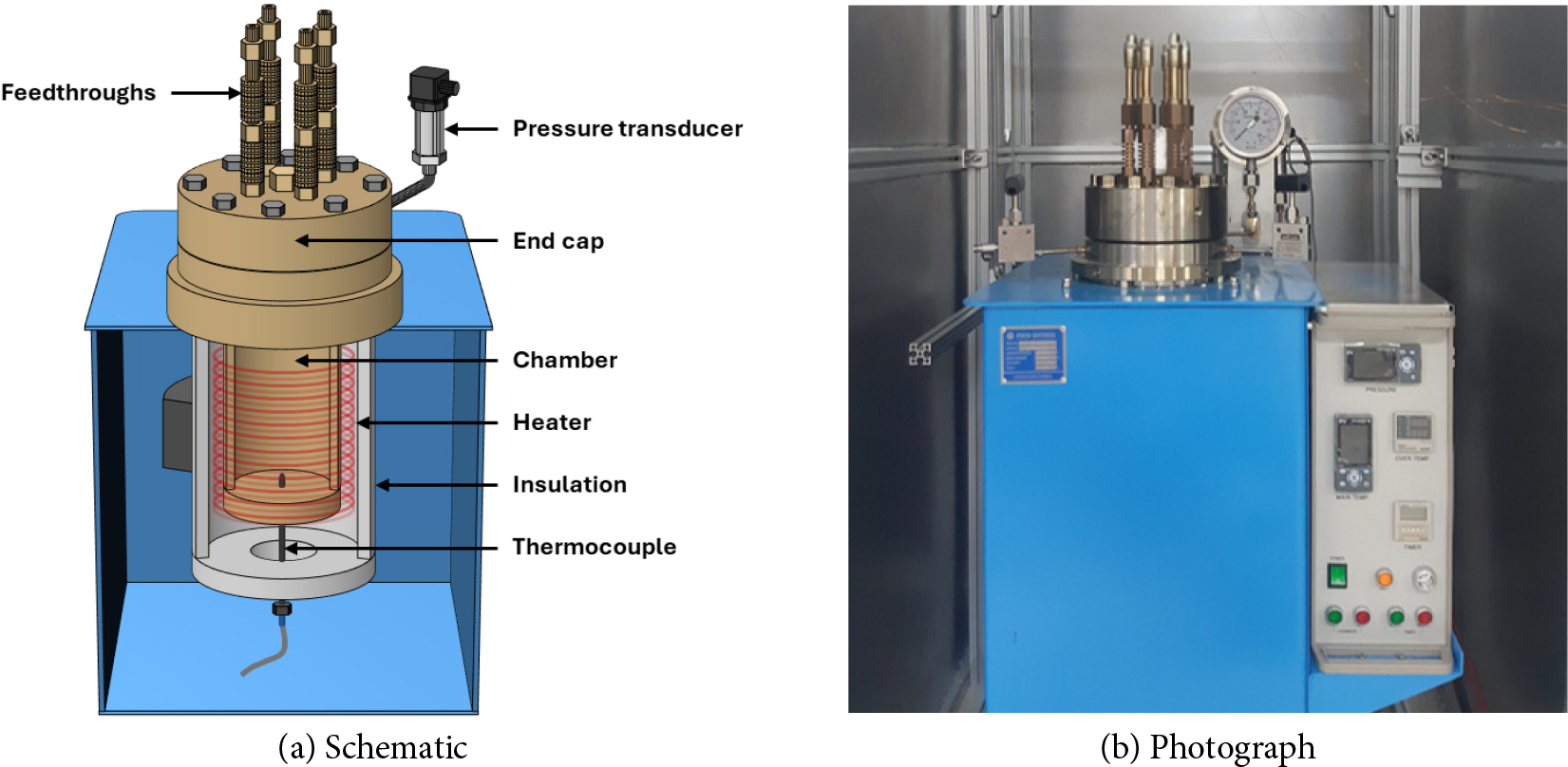
To measure supercritical thermophysical properties such as density, viscosity, and thermal conductivity, a specialized chamber capable of withstanding high pressure and high temperature was designed and fabricated. The chamber was required to withstand sufficiently severe conditions to bring reference fluids, including water and carbon dioxide, into their supercritical states for validation. In particular, the chamber had to be sufficiently large to house multiple thermophysical property measurement devices installed within it. Therefore, the chamber size was determined by thermal conductivity and viscosity measurement devices, as these instruments require the largest internal volume. The fabricated chamber shown in Fig. 1 has an internal volume of 1.57 L. Inconel 625 was selected as the chamber material to ensure mechanical integrity and corrosion resistance under supercritical conditions. Also, it is designed to withstand temperatures up to 400°C and pressures up to 300 bar. The chamber was heated using a ceramic band heater to pressurize the fluid in the chamber, while the corresponding temperature and pressure were monitored using thermocouples (OMEGA, K-type) and a pressure transducer (Balluff, BSP00F3).
2.1 Supercritical density measurement
Previous studies [15,16] have adopted flow-based approaches for density measurements of fluids under high-temperature and supercritical conditions. Nevertheless, flow-based methods require accurate flow rate control and careful correction of pressure drop effects, while the strong property distortion in the pseudo-critical region may cause flow instability and fluctuations in pressure and temperature. For thermally stressed hydrocarbon fuels relevant to supersonic and hypersonic aircraft, these issues make it difficult to maintain a well-defined measurement state throughout the flow path. Therefore, the present study employed a constant-volume method to determine the supercritical density of fluids. The supercritical density of fluids was measured using the chamber equipped with temperature and pressure sensors, as shown in Fig. 1, based on the constant-volume method. In the present method, the internal volume of the chamber was fixed and precisely known. The mass of the fluid injected into the chamber was measured prior to sealing. Therefore, the supercritical density of fluids was determined using Eq. (1).
where P, T, m, V, and ρ are pressure, temperature, mass, volume, and density, respectively. After injecting a known mass of fluid into the chamber of fixed volume, the density of the enclosed fluid is fixed. The temperature of the fluid is then increased incrementally, while the corresponding pressure is recorded at each temperature step. This procedure yields pressure-temperature data at constant density. The uncertainty analysis of supercritical density was evaluated using Eq. (2).
where uρ, uρ(P), and uρ(T) are uncertainty of density and uncertainty contributions to density due to pressure and temperature measurements, respectively. The resulting density uncertainty of in-house developed system was ±5.44%.
2.2 Supercritical viscosity measurement
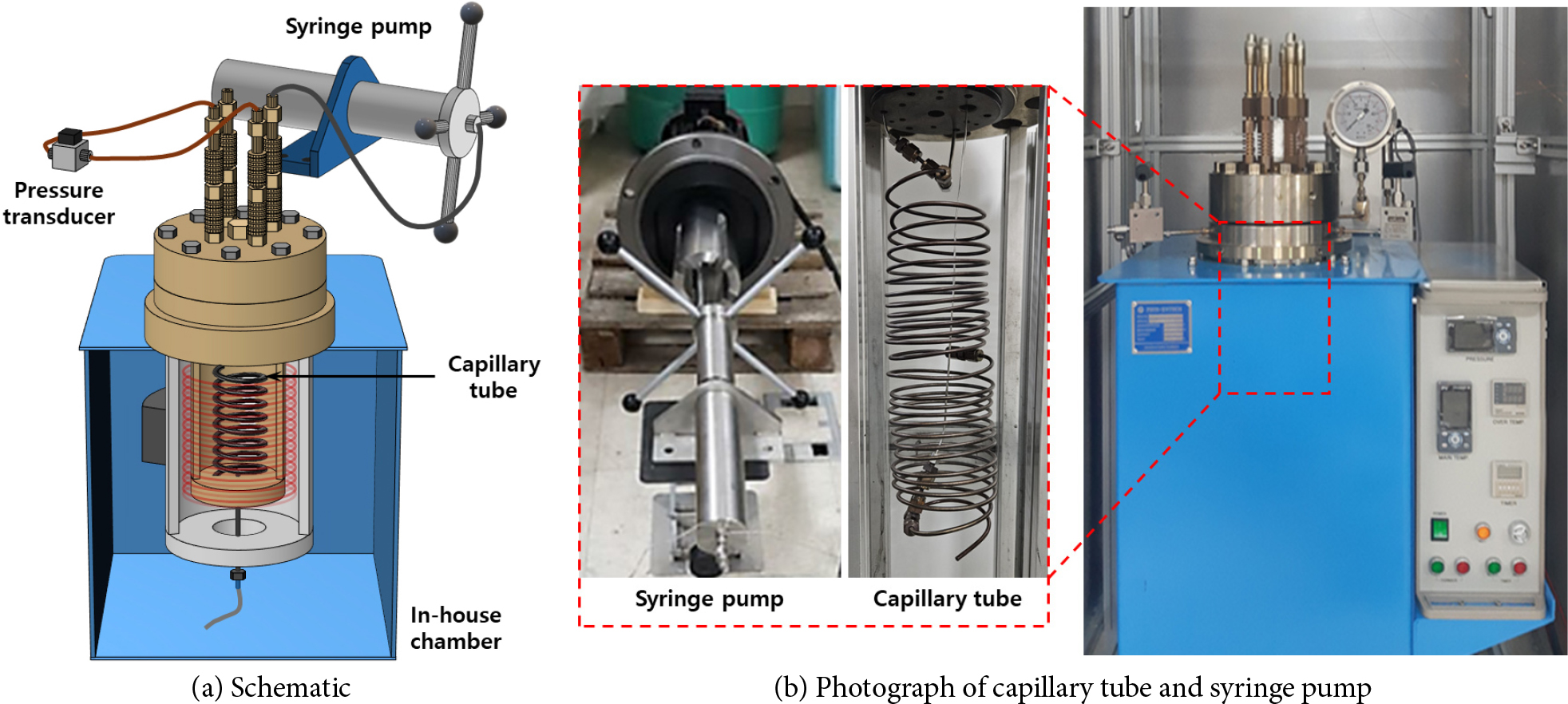
The supercritical viscosity was determined using a capillary viscometer that measures viscosity through pressure drop generated through a capillary tube [17], as shown in Fig. 2. Capillary tube-based viscometry is one of the most widely used methods for measuring the viscosity of fluids under high-temperature and supercritical conditions [17,18,19]. In previous studies, the test fluid was typically heated and pressurized before entering the test section in a flow-through configuration. However, in this study, the capillary tube was placed directly inside the specialized chamber, which is beneficial for maintaining a more consistent supercritical environment with reduced temperature variation along the test section. The system consists of a capillary tube, a differential pressure transducer (Validyne, DP303), and a syringe pump system. Since supercritical fluids typically exhibit very low viscosities, comparable to those of gases, a sufficiently long flow channel is required to produce a measurable pressure drop. Thus, a tube with an inner diameter of 1/8 inch and a total length of 5 m was employed as the flow channel. To fit the long flow channel within a limited space, the capillary tube was configured in the form of a helical coil. The coiling effect caused by channel curvature increases the pressure drop but becomes negligible at sufficiently low Dean numbers [20], which can be expressed by Eq. (3)
where De, din, Re, and κtube are Dean number, inner diameter of the capillary tube, Reynolds number, and curvature radius of the capillary tube, respectively. The coiling effect can be neglected for Dean number below 25, as the associated pressure drop differs by less than 1% from that of a straight tube [20,21]. Therefore, a syringe pump with a flow rate uncertainty of ±5.86% was used to precisely control the volume flow rate, resulting in Dean number below 4.5 under the present experimental conditions.
The viscosity was calculated from the pressure drop across the capillary tube using the Hagen-Poiseuille relation, as expressed by
where L, ∆P, Q, and μ are length of the capillary tube, pressure drop, volume flow rate, and viscosity of the fluid, respectively. Eq. (4) assumes laminar and fully developed flow in a circular tube. Under the present experimental conditions, the Reynolds number was maintained below 300, satisfying the laminar-flow assumption, while the sufficiently long tube length made the entrance effect negligible relative to the total pressure drop. The measured pressure drop was also very small compared with the operating pressure, indicating that the compressibility effect was negligible. The uncertainty of the capillary viscometer was determined using Eq. (5).
where , , , , and are uncertainties of inner capillary tube diameter, capillary tube length, pressure drop, volume flow rate, and viscosity, respectively. Each uncertainty was obtained by combining the bias error of the components and the precision error [17]. The bias error consists of the accuracy and resolution of the vernier calipers, pressure transducer, and balance, while the precision error reflects the variability observed in repeated measurements. Based on the uncertainty analysis, the overall uncertainty of the in-house capillary viscometer is ±7.45%.
2.3 Supercritical thermal conductivity measurement
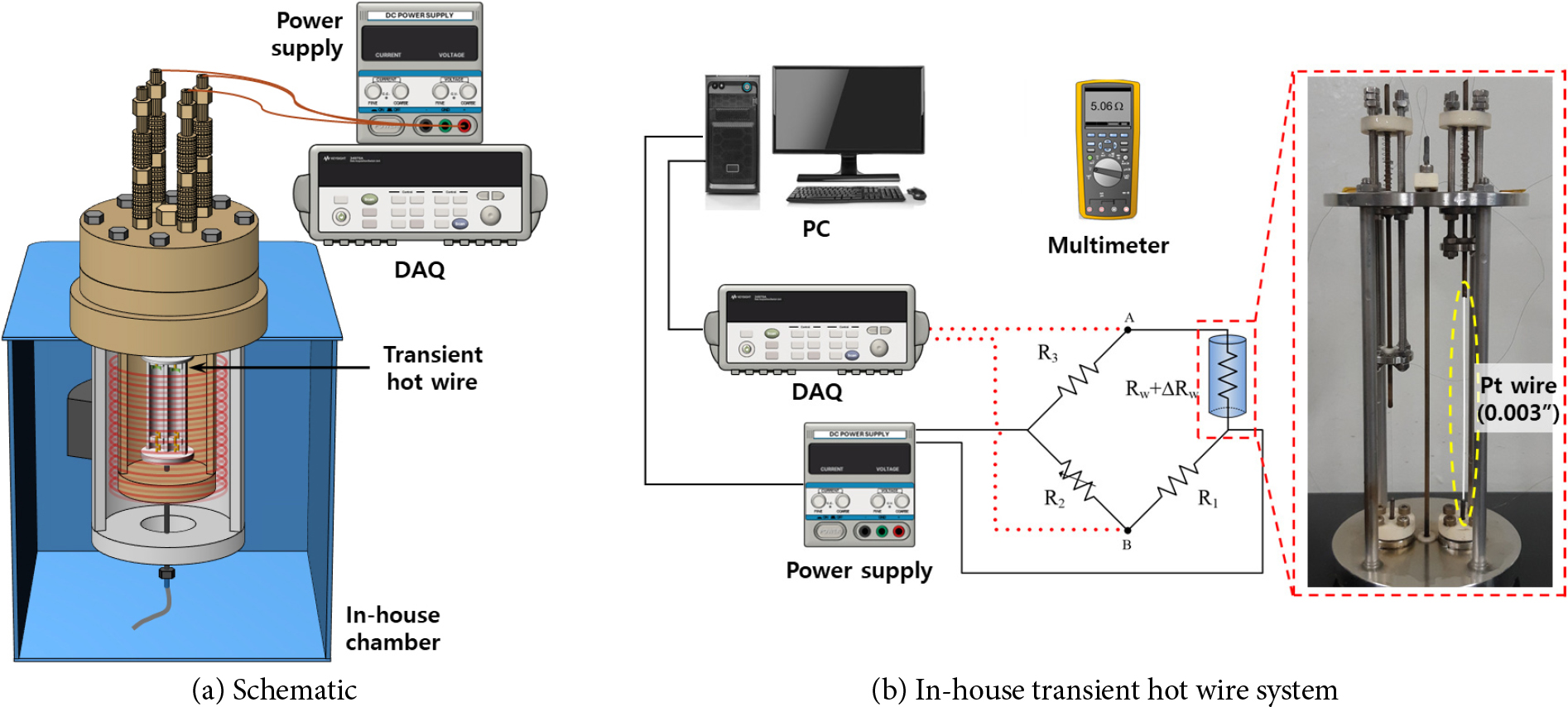
The supercritical thermal conductivity was measured using a THW (Transient Hot Wire) method [17], as shown in Fig. 3. The THW system developed in this study was based on the conventional THW configuration [22], with modifications implemented to account for supercritical conditions [17]. In particular, a platinum wire with a diameter of 0.003 inch was chosen as the hot wire to minimize radial temperature gradients within the wire, thereby ensuring the validity of the transient hot-wire formulation. Furthermore, the placement of the THW device inside a specialized chamber provides a relatively large surrounding fluid region around the wire, which can help reduce boundary effects and improve the applicability of the ideal transient hot-wire assumption based on pure conduction from a line heat source in an infinite medium. Prior to each experiment, the resistances of the precision resistors (R1) and (R3), as well as the initial resistance of the platinum wire (Rw), were measured using a multimeter (Fluke, Fluke 289). The resistance R2 was then adjusted using a high-accuracy resistance decade box (IET Labs. Inc., HARS-X series) to satisfy the Wheatstone bridge balance condition (R1Rw = R2R3) among the four resistive elements. Once the bridge was properly balanced, electrical power is supplied to the hot wire using a power supply to generate a stepwise heat input. During the measurement, voltage signals from the Wheatstone bridge are acquired using a DAQ (Data Acquisition) system and recorded by a PC. Then, the thermal conductivity of the fluid is evaluated from the temperature rise of the hot wire, which is derived from the time-dependent resistance response, as expressed by
where Lw, S, k, q, t, ∆T, and V0 are length of the wire, slope of ln t-∆T, thermal conductivity, input power per unit length, time, and temperature rise, respectively. The reliability of the measured thermal conductivity depends on the linearity of the temperature rise with respect to the logarithmic time, since the heat dissipation per unit length remains constant. Therefore, experimental data were selected based on linear regression analysis, with only data exhibiting a linearity greater than 99% being used. In the present measurements, linear behavior was maintained up to 0.1 s. Beyond this time, deviations arose due to the onset of natural convection. Thus, the thermal conductivity was evaluated using data within the initial 0.1 s interval, where natural convection effects are negligible. The uncertainty was estimated using Eq. (7) based on Eq. (6).
where , , and are uncertainties of thermal conductivity, input power per unit length, and temperature rise, respectively. Each uncertainty was evaluated by combining the bias errors of the individual components with the precision error. As a result, the uncertainty of the in-house THW system was determined to be ±9.25%.
3. Results and Discussion
To validate the reliability of the developed experimental systems for density, viscosity, and thermal conductivity, experiments were conducted over a wide range of temperatures and pressures using DI-water (H2O) and carbon dioxide (CO2). The supercritical thermophysical properties of these fluids reported in the NIST Chemistry WebBook [14] were used as reference data for validation, as they are well documented in the literature through both theoretical models and experimental measurements.
Fig. 4 shows the validation results of the supercritical density measurement system using supercritical water (sH2O) and supercritical carbon dioxide (sCO2). Fig. 4(a) compares the measured densities of sH2O and sCO2 at 400°C with reference values obtained from the NIST Chemistry WebBook [14]. The experimentally measured densities show good agreement with the NIST reference data [14] within the evaluated uncertainty of ±5.44%. This agreement confirms the capability of the constant-volume method to accurately measure fluid density under supercritical conditions. Fig. 4(b) presents the density measurements of sH2O over a range of pressures at different temperatures between 380.0°C and 387.5°C. The measured density data follow the pressure-dependent trends predicted by the NIST reference data [14] at each temperature. In Fig. 4(b), the black, red, blue, and green solid symbols represent the experimentally measured density data obtained in the present study at 380.0°C, 382.5°C, 385.0°C, and 387.5°C, respectively, while the lines in the corresponding colors denote the reference values at each temperature. Across the investigated temperature and pressure ranges, the experimental results consistently fall within the uncertainty ranges. The relative deviations of the measured density from the NIST reference data [14] are summarized in Table 1. It is shown that the developed density measurement system based on the constant-volume method provides reliable density measurements under the supercritical regime.

Table 1.
Relative deviations between the experimental data and the NIST reference data [14].
The validation results of the developed supercritical viscosity measurement system using sH2O and sCO2 are shown in Fig. 5. In Fig. 5(a), viscosity measurements of sH2O obtained between 380 and 400°C at pressures ranging from 232.9 to 274.3 bar are presented. Although a slight increase in viscosity with temperature is observed, the variation remains within the uncertainty ranges, suggesting minimal temperature dependence of supercritical viscosity over the given conditions. For sCO2, Fig. 5(b) presents viscosity measurements conducted in the temperature range of 380-400°C at pressures between 138.0 and 166.6 bar. The measured viscosity of sCO2 shows only minor variation with temperature under the given conditions, remaining within the uncertainty ranges. Based on the results shown in Fig. 5(a) and (b), the developed viscosity measurement system is validated, as the experimental data for both sH2O and sCO2 are consistent with the corresponding reference data [14] within the evaluated uncertainties of ±7.45%. As summarized in Table 1, the relative deviations of the measured viscosity from the reference data were within 1.01% for sH2O and 6.36% for sCO2 under the present experimental conditions.
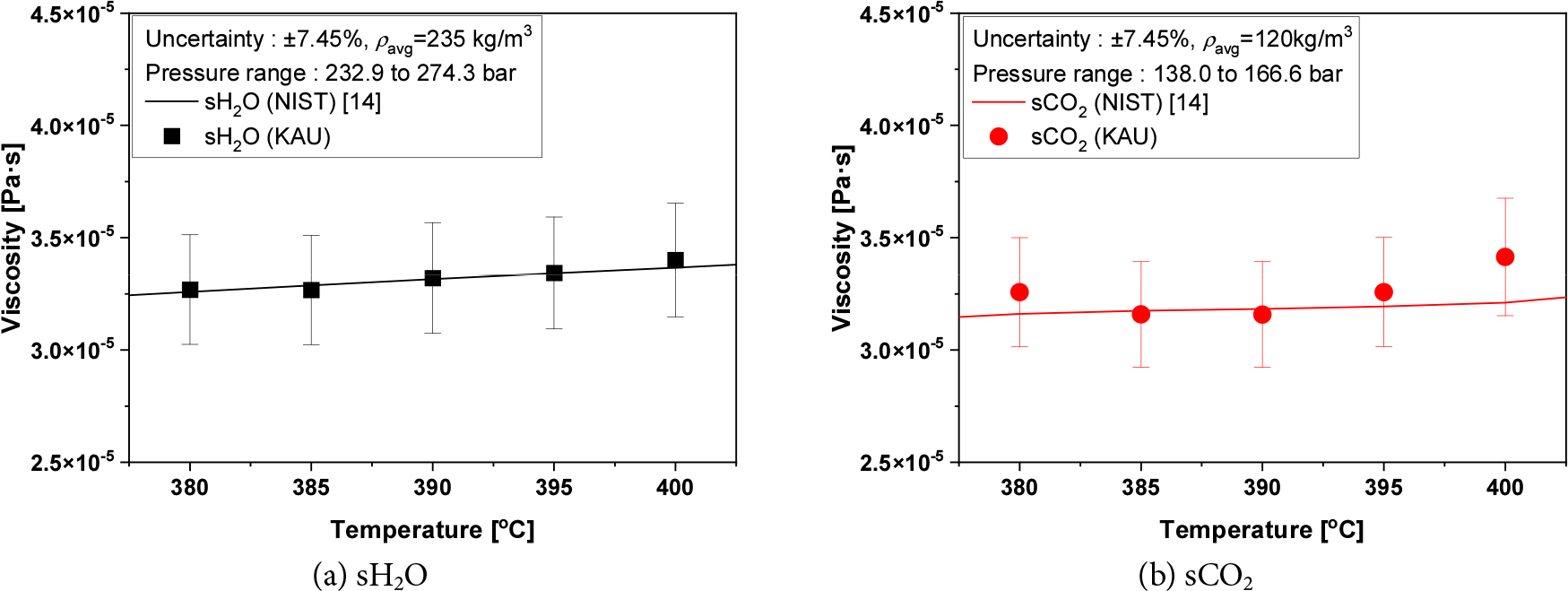
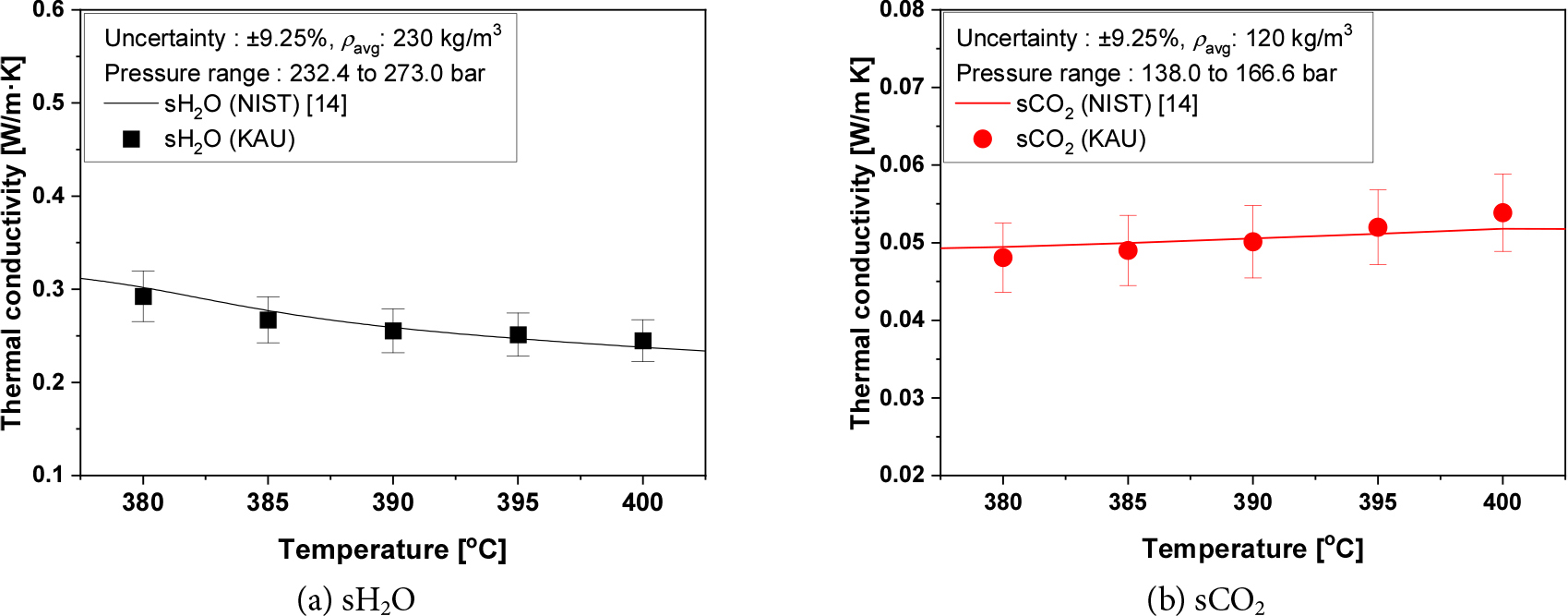
Fig. 6 shows the supercritical thermal conductivity data obtained using the developed supercritical thermal conductivity measurement system. For sH2O as shown in Fig. 6(a), the variation of thermal conductivity was measured at temperatures between 380 and 400°C under pressures ranging from 232.4 to 273.0 bar. A decreasing trend in thermal conductivity with increasing temperature is observed, which is consistent with the typical behavior of sH2O in this temperature range. Throughout the measurements, the experimental data remain within the evaluated uncertainty ranges of ±9.25%. Also, as shown in Fig. 6(b), the thermal conductivity results for sCO2 are presented at temperatures from 380 to 400°C and pressures between 138 and 166.6 bar. Considering the uncertainty of the system, the thermal conductivity of sCO2 shows no significant variation with temperature over the given conditions. The results in Fig. 6(a) and (b) show that the developed thermal conductivity measurement system provides reliable supercritical thermal conductivity data for both sH2O and sCO2 when compared with reference values [14] within the evaluated uncertainty limits. Table 1 indicates that, under the present experimental conditions, the relative deviations of the measured thermal conductivity from the reference data remained below 3.49% for sH2O and 4.00% for sCO2.
4. Conclusion
In this study, measurement methodologies were developed and validated to determine the supercritical thermophysical properties of fluids, providing a validated experimental framework for future measurements of supercritical fuel properties used for regenerative cooling in high-speed propulsion systems. A specialized high-pressure and high-temperature chamber was designed and fabricated to create a controlled supercritical environment. With the chamber, independent measurement systems for density, viscosity, and thermal conductivity were developed using the constant-volume method, a capillary viscometer, and the transient hot wire method. Uncertainty analyses were conducted for each measurement system to quantify the corresponding measurement uncertainties, yielding uncertainty ranges of ±5.44% for density, ±7.45% for viscosity, and ±9.25% for thermal conductivity. The developed experimental systems were validated by comparing the measured results with reference data from the NIST Chemistry WebBook [14] using DI-water and carbon dioxide over wide ranges of temperature and pressure in the supercritical regime. The measured supercritical thermophysical properties exhibited good agreement with the reference data [14] within the evaluated uncertainty ranges. The validation results show that the proposed experimental systems and methodologies provide reliable measurements of supercritical thermophysical properties under high-temperature and high-pressure conditions. The developed framework provides a robust experimental basis for future studies on supercritical fuel properties, supporting improved accuracy in the thermal performance prediction and design of regenerative cooling systems for high-speed propulsion applications.